Value Proposition
Our Vision
The Problem
Active transportation is significantly underutilized in modern cities, particularly in North America. Only 1.2% of the land mass of the largest 35 metropolitan areas in the US are walkable urban areas (World Economic Forum, 2023). This trend is worsening with time - the percentage of schoolchildren who biked or walked decreased from 42% in 1969 to 10.4% in 2017 (The Japan Times, 2024).
While traffic infrastructure can divide communities and reduce social connections (Mindell & Karlsen, 2012), many people forgo active transportation due to the perceived time investment and lack of engaging experiences during their journey.
Our Solution
Our app transforms walking into a socially engaging and fulfilling experience. By adding social and gamified elements to active transportation, we aim to promote healthier lifestyles, reduce reliance on cars, and encourage community connections.
Unlike existing solutions such as Nextdoor or Pokémon GO that either focus solely on community information or outdoor gaming, our approach uniquely integrates social engagement with daily commuting needs, making active transportation more appealing for practical journeys.
Target Impact
Impact Goals
- Increase active transportation usage by 30% among users
- Foster meaningful local connections through shared activities
- Reduce car usage for short trips by 20%
Market Segment
Target Audience
- Students
- Working professionals
For some people, it would be infeasible to walk rather than take buses or drive because of the significant differences in time it would take. For others, they would stay at home doing other forms of social interaction, rather than getting some fresh air by taking a walk outside. Out of all the people who do not utilize active transport, we narrowed down the target audience for our app to students and working professionals living in cities. These people often commute to a lot of places but find walking not socially engaging enough to be worthwhile.
Problem Space
Identified Niches
Active Transportation Barriers
- Lack of motivation for regular walking activities
- Limited awareness of interesting local routes
- Missing social connection in daily commutes
- Insufficient engagement with local community spaces
Solution Approach
- Gamified walking experience with virtual pet companion
- Community-curated landmarks and points of interest
- Social features integrated into daily routes
- Real-time community engagement opportunities
Project Focus
Our project addresses three core problems in active transportation:
- Motivation Gap: Traditional fitness apps lack engaging social elements that could make active transportation more appealing for daily use.
- Awareness Gap: People often commute to a lot of places but find walking unengaging and uninvolved.
- Social Connection Gap: Traditional fitness apps lack social connection in daily commutes.
Focus Areas
Key Solutions
- Gamified walking experience with social rewards
- Community-driven points of interest and events
- Real-time social interaction features
Expected Impact
- 30% increase in walking activity
- 50% boost in local community engagement
- 20% reduction in car usage for short trips
Initial Brainstorming
Feature Brainstorm
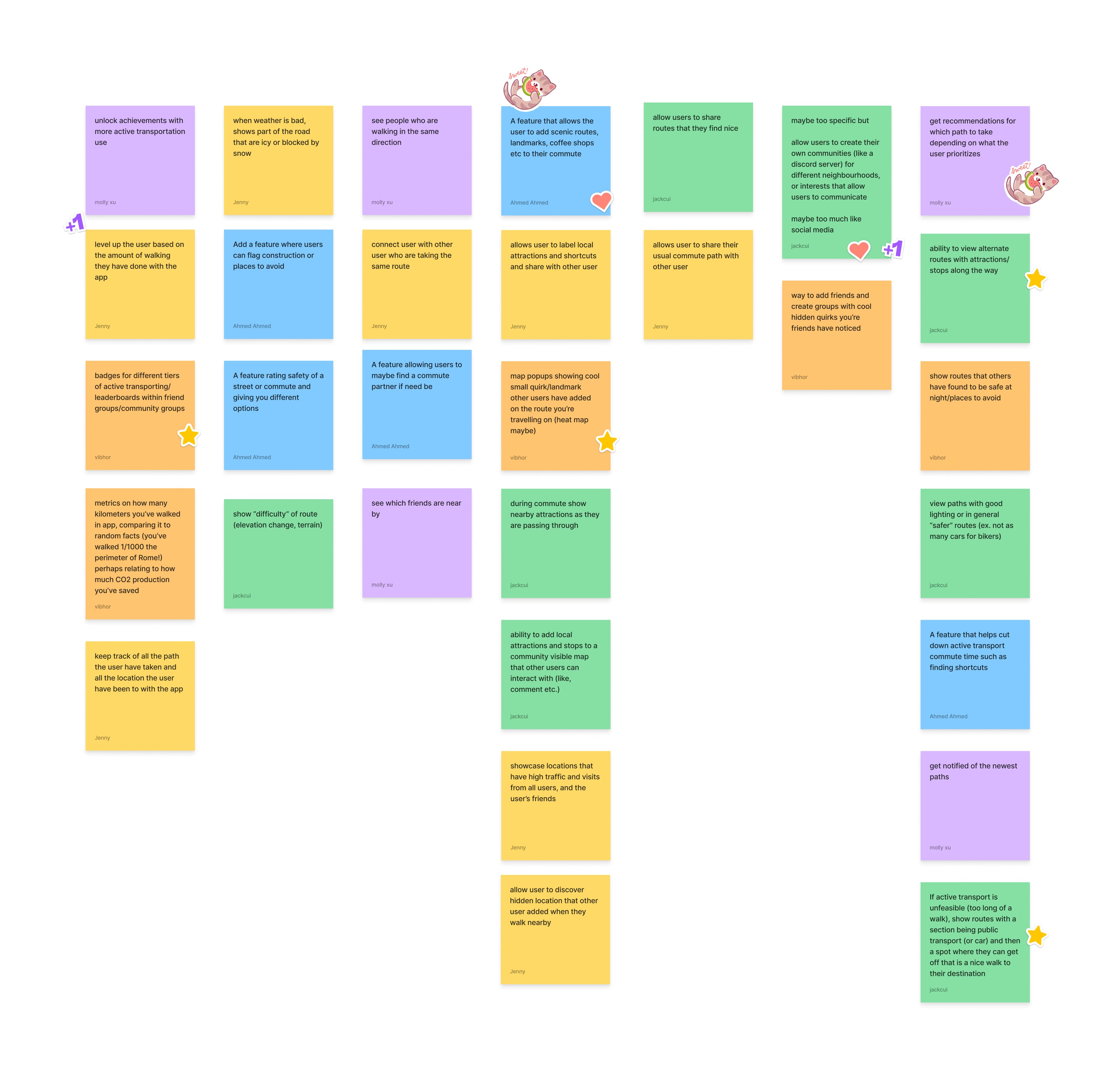
Our initial brainstorming session focused on identifying key features that would address the core problems while promoting active transportation and community engagement.
Through collaborative discussion and ideation, we explored various possibilities for encouraging sustainable transportation habits while building social connections.
Citations
World Economic Forum. (2023). "The State of Urban Walkability in US Metropolitan Areas." Retrieved from https://www.weforum.org/reports/urban-walkability-2023
The Japan Times. (2024, May 17). "America's walking health crisis deepens as urban sprawl continues." Retrieved from https://www.japantimes.co.jp/commentary/2024/05/17/world/america-walking-health/
Mindell, J. S., & Karlsen, S. (2012). "Community Severance and Health: What Do We Actually Know?" Journal of Urban Health, 89(2), 232-246. https://www.sciencedirect.com/science/article/abs/pii/S2214140515002224
Made while petting a virtual cat 🐱
© 2024 Motion